The bond screen shows ₹10,100. The final payment request is higher. Has something gone wrong?
Not necessarily. The quote may exclude interest that has accumulated since the last coupon, and the transaction may include charges. The important thing is to understand each component before authorising payment.
Separate the price from the amount payable
A clean price excludes accrued interest. A dirty price includes it. Charges, where applicable, may sit outside both. Check the convention used on the screen: some prices are expressed per unit, others per ₹100 of face value, and a quoted percentage is not always a rupee price.
For an illustrative order, assume a clean amount of ₹10,100, accrued interest of ₹200 and charges of ₹25. The cash payable is ₹10,325. This is an invented breakdown, not a typical fee schedule. The RBI primer explains accrued interest and bond-price conventions.
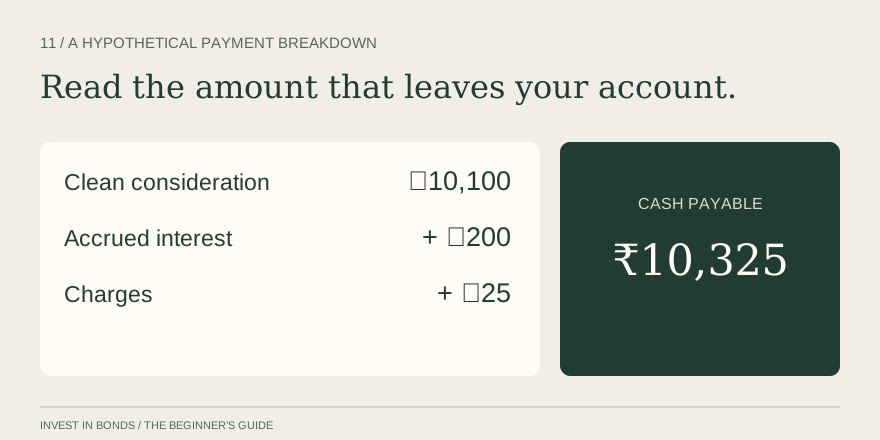 Illustrative amounts only. Actual day-count, settlement, charges and taxes must be checked for the transaction. View full-size diagram
Accrued interest is not a surprise bonus
When a bond trades between coupon dates, the settlement convention may compensate the seller for interest accrued during their holding period. The next coupon paid to the buyer therefore needs to be considered alongside the accrued interest paid at purchase.
Suppose, purely for illustration, you pay ₹200 of accrued interest and later receive a ₹400 coupon. Treating the whole ₹400 as income earned only since your purchase would misdescribe the economic cash flows. You have already paid for part of that accrual. Tax reporting can require separate treatment; keep the transaction breakdown rather than improvising from the bank credit alone.
Record dates as well as amounts. A day-count convention determines how a period is measured. Odd coupon periods and record-date arrangements can complicate a simple proportional calculation. Use the verified settlement amount for the real order.
A zero brokerage label does not answer every cost question
Ask about brokerage, platform charges, applicable statutory charges, taxes on services and any custody costs. Also look at the bid–ask spread: buying at one price and being able to sell only at a lower price is economically relevant even if no separate commission line appears.
Compare the total amount leaving your account and the expected net amounts returning. A platform’s fee label should not replace that calculation. Keep the order breakdown and final transaction record so you can reconcile the two.
Tax starts with classification
This chapter is written for a resident individual investing on personal account, with sources checked for the September 2026 edition. It explains the questions to resolve; it is not an individual tax computation. NRI treatment, business holdings, unusual structures and exemptions can require separate advice.
Distinguish interest from a gain or loss on transfer or redemption. Then identify the instrument, listing status, purchase and disposal dates, holding period and any special provision. The Income Tax Department’s capital-gains guidance describes special treatment for market-linked debentures and unlisted bonds/debentures, including the relevant date conditions. Holding longer does not automatically secure long-term treatment for every debt instrument.
Ordinary listed-bond capital gains, interest receipts, specified debt-fund units and market-linked instruments should not be put into one universal “bond tax rate” box. Nor should an exemption associated with listed equity be casually applied to bonds.
| Receipt or event | What to establish before calculating tax |
|---|---|
| Coupon or other interest | Whether it is taxable or specifically exempt; when it is recognised; the investor’s applicable rate |
| Sale or redemption | Whether a capital gain arises, the allowed cost and expenses, and the applicable classification |
| Unlisted bond or market-linked debenture | Whether a special deemed short-term rule applies to this instrument and event |
| A product marketed as tax-free or tax-saving | The exact provision, eligible investor, covered receipt and conditions |
The 2026 transition matters when reading old articles
The Income-tax Act, 2025 came into effect on 1 April 2026, with transitional provisions preserving the earlier framework for relevant earlier periods. The department’s official explanation distinguishes the new tax-year system from earlier assessment years.
An article citing a section of the 1961 Act may describe an earlier transaction correctly without being the right statutory reference for a new one. Match the rule to the period. For a filing decision, check the applicable Act, amendments and official instructions rather than relying on an undated tax table.
TDS is a deduction mechanism
Tax deducted at source is money withheld under the applicable rules. It is not automatically your final tax liability, and the absence of a deduction does not by itself make a receipt exempt. Reconcile deductions with your tax records and the issuer’s documentation. The department maintains TDS compliance guidance.
Use an intentionally simplified example. Suppose ₹800 of interest is taxable at an assumed effective rate of 20%, with all other complications excluded. The tax attributable to it is ₹160, leaving ₹640. If an assumed ₹80 was already withheld, that is a credit towards the calculation rather than an additional ₹80 tax on top. These are hypothetical rates for arithmetic, not a statement of the deduction or tax rate on your bond.
Avoid the shortcut of taxing the whole yield
Multiplying YTM by “one minus my tax rate” can be misleading when coupons, capital gains, timing and exemptions are treated differently. Instead, model the receipts, relevant taxes and costs on their dates. Then compare the resulting cash flows on a consistent basis.
For a first investment, keep the records simple and complete: purchase confirmation, accrued-interest split, coupons, deductions, sale or redemption proceeds and expenses. A tax professional can work with clear records much more reliably than with a single advertised yield.
The useful return is the one you can reconcile with the money leaving and entering your account.
Before buying, identify any tax question that could materially change your comparison. Resolve it while you still have the option to choose a simpler investment.