The purchase is complete. For a moment, the work feels finished.
Then a coupon arrives, a rating update appears, or your own plans change. A bond does not require constant screen-watching, but it does benefit from a small, reliable system.
Your aim is to know what you own, what should happen next and what to do if the actual outcome differs.
Create one dependable record
For each holding, record the issuer, ISIN, quantity, face amount, purchase date, settlement date, total cost and payment schedule. Add the custody account, current rating details, relevant options and links to the documents you used.
Keep the order record, bank debit and holding statement together. NSDL’s explanation of consolidated statements describes one way to view dematerialised investments. Reconcile with the records appropriate to your own account; RDG holdings have their separate records.
Do not store passwords, PINs or OTPs in the tracker. It is an investment record, not a collection of account-access credentials. Keep sensitive account identifiers private if you share a worksheet with someone helping you.
Track expected and actual payments separately
A calendar says when something should happen. A bank record shows whether it did. Keep both.
For our hypothetical bond, the schedule lists ₹800 at each annual coupon date and ₹10,000 principal at the end. Your actual record should separately show gross interest, any tax deduction, net bank credit and the date received. If principal is repaid in instalments, update the remaining face amount after each repayment.
| Date due | Expected receipt | Actual gross receipt | Tax deducted | Net credited | Follow-up |
|---|---|---|---|---|---|
| Enter verified date | Interest or principal | Check advice | Check records | Match bank | Note any difference |
Avoid using a rising portfolio valuation as evidence that income was received. A valuation and a cash payment answer different questions.
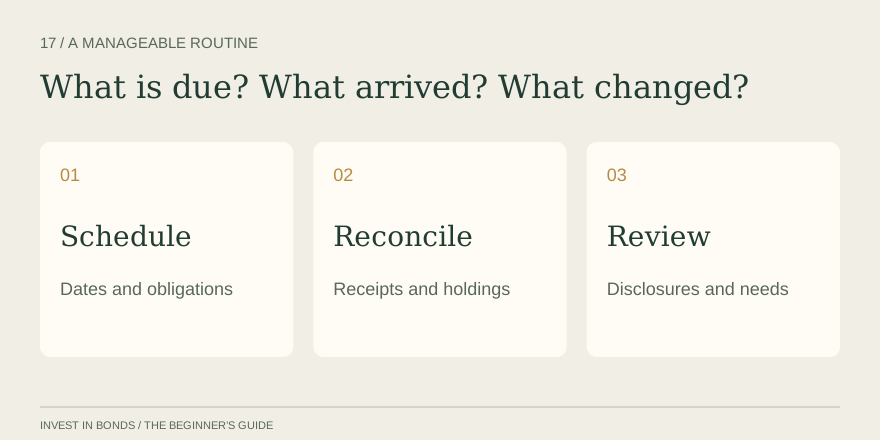 A simple routine is easier to maintain than constant price checking. View full-size diagram
If a payment does not arrive
First establish the facts. Check the contractual due date and any applicable business-day adjustment. Confirm your entitlement and the registered bank details. Look for an issuer or registrar notice, a payment advice or a rejected-credit explanation.
Then contact the relevant official support channel with a specific record: ISIN, holding, due date, expected amount, transaction reference and what is missing. For a corporate issuer payment, the issuer/registrar and trustee may be relevant; an order or settlement issue may require the intermediary or depository participant. For Retail Direct service issues, use its official support route.
A delayed credit should be investigated rather than immediately labelled either harmless or a confirmed credit default. Equally, repeated reassurance without evidence is not a reason to stop following up. Keep a dated record of the responses.
For matters within SEBI’s grievance framework, SCORES explains that you should first approach the entity concerned and can then use the applicable complaint process. Complaint facilitation does not guarantee repayment or compensation. Some disputes require other routes; follow the platform’s current scope and guidance.
Monitor the facts that supported the purchase
Return to the review triggers in your decision note. Check new rating actions, material issuer disclosures, financial updates and notices affecting payments or security. SEBI’s ratings FAQ describes ratings as opinions that can change as information and circumstances change.
There is no single monitoring frequency that suits every instrument. Use the payment schedule and material events, and set a periodic review that you can actually maintain. A complicated holding that requires attention you cannot provide may be a poor fit even if it looked manageable on purchase day.
Do not confuse a routine lower market value with a new credit problem, but do not dismiss a price move without checking whether credit information has changed. The record you built makes that distinction easier.
Selling before maturity
If your circumstances change, revisit the purpose and obtain an actual exit quote or order-book view for your quantity. Check clean versus dirty price, charges, taxes and settlement timing. A displayed valuation is not a promise of sale proceeds.
Compare the economic result using all cash flows: original purchase outflow, coupons already received, and net sale proceeds. Do not judge the result only by comparing the sale price with face value.
For example, if an invented investment cost ₹10,200, paid you ₹800 and was sold a year later for ₹10,000, the simple cash surplus before further costs and taxes is ₹600. That is not a universal annualised-return calculation; it is a reminder to include both income and price. Dates and charges are needed for a precise realised return.
Calls, maturity and reinvestment
Read any call or redemption notice and confirm the payment terms. An allowed call can end the investment earlier than your original plan. At maturity, reconcile both the final interest and principal, and check the holding record is updated appropriately.
Decide what the returned money is for before reinvesting. You do not have to reproduce the previous coupon. Your needs, tax position, market choices and issuer exposures may have changed.
If a repayment arrives in pieces or there is a restructuring, keep the records and seek appropriate help. Do not assume that a platform’s old YTM continues to describe the holding after its actual payment terms change.
Make the records useful to someone else
Keep account-location and official contact information in a secure place your family can locate when needed. Review nomination details through the relevant service and consider your wider estate arrangements separately. The purpose is continuity, not sharing access credentials casually.
Owning a bond means maintaining a small set of facts: what is due, what arrived and what changed.
The first investment has now become a full cycle. The last chapter brings that cycle into a longer-term habit without turning a beginner’s guide into a promise of a perfect portfolio.