Imagine that a business asks to borrow ₹10,000 from you. It offers to pay ₹800 at the end of each year and return your ₹10,000 after three years.
You might immediately ask three questions. Who is borrowing? Where will the repayments come from? What happens if something goes wrong?
Those are sensible questions. You have already begun thinking like a bond investor.
The arrangement above is a simplified, hypothetical example. It is not a real offer or a suggested return. We will return to it throughout this guide because understanding one straightforward bond is more useful than memorising a page of definitions.
A loan you can identify
A bond is a debt security: a documented borrowing arrangement with specified terms. The borrower is called the issuer. The investor who holds the bond has rights under those terms. Governments and companies use debt securities to raise money; the conditions differ across issuers and instruments. SEBI’s introduction explains this basic relationship.
Think of the paperwork as a set of answers. It identifies the borrower, describes the payments and records the conditions under which they are due. In later chapters, we will learn to read those answers before looking at a large percentage on an investment screen.
A bond is not an informal favour. Your decision rests on an enforceable arrangement, the issuer’s ability to meet it and the price you pay. The existence of a contract is useful. It does not make the borrower incapable of failing.
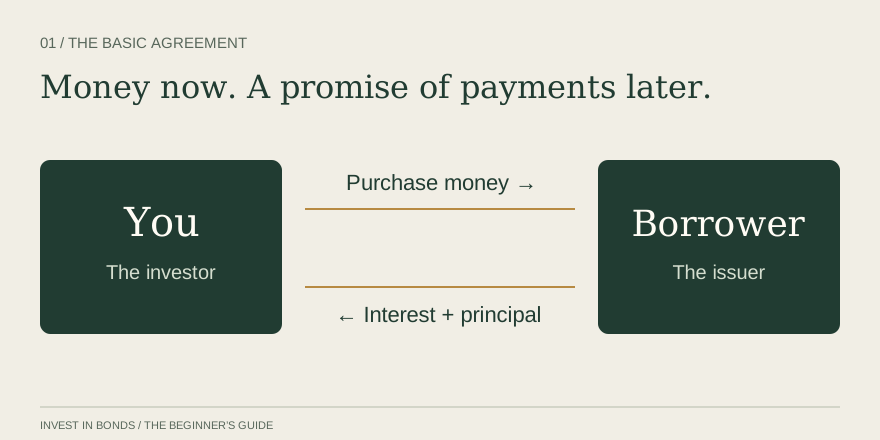 The basic relationship. Payments depend on the contract and the issuer meeting its obligations. View full-size diagram
Follow the money
For our example, assume you buy the bond when it is issued, pay exactly ₹10,000, and receive every scheduled payment on time. Ignore taxes and charges for now. There is no early repayment option and no repayment of principal in instalments.
| When | Money paid by you | Money received by you |
|---|---|---|
| At purchase | ₹10,000 | — |
| End of year 1 | — | ₹800 interest |
| End of year 2 | — | ₹800 interest |
| End of year 3 | — | ₹800 interest + ₹10,000 principal |
The total money received is ₹12,400. Of that, ₹10,000 is the return of your original principal. Your interest receipts add up to ₹2,400 before tax and costs.
This distinction matters. A large repayment at maturity is not all profit. Some of the money is simply coming home.
Nor should we call ₹2,400 an annual return. It is interest received across three years. Timing matters when comparing investments. Receiving ₹800 each year is a different cash-flow pattern from receiving all the interest at the very end, even if the rupee total looks similar.
A lender and an owner ask different questions
Buying a company’s shares gives you an ownership interest. Buying its bond makes you a creditor under a particular contract. An owner may benefit from a business becoming far more valuable. A holder of an ordinary fixed-rate bond is generally entitled to the agreed payments, rather than a share of every increase in the business’s profits.
Imagine our hypothetical borrower doubles its profits. That does not automatically double the ₹800 coupon. Now imagine its cash position deteriorates. The obligation may still exist, but its ability to pay may be in doubt.
This explains why the bond investor’s central question is often practical: can the borrower meet the payments when they fall due? A compelling business story is not, by itself, an answer.
You can buy a promise from someone else
Not every bond purchase gives fresh money to the issuer. A new issue is part of the primary market. A later trade between investors takes place in the secondary market.
Suppose another investor already owns our example bond and wants to sell it. You might agree to buy it at a price above or below ₹10,000. The remaining contractual payments do not become larger merely because you paid more. Your purchase price changes what those payments are worth to you.
We will calculate that difference in Chapter 5. For now, hold on to a useful separation: the issuer makes the payment promise; the market helps determine what someone will pay for that promise today.
Fixed income does not mean every outcome is fixed
The phrase fixed income can create an unfortunate shortcut in the mind: fixed payment, therefore fixed result. In practice, bonds have different structures. Some pay fixed coupons, some reset their interest rates, and some do not pay periodic interest at all. Selling before maturity introduces a price you may not know today. Default can interrupt the payment schedule.
Even when every payment arrives as agreed, inflation and taxes affect what those rupees can do for you. We will unpack these ideas gradually. You do not need to master them before continuing; you only need to avoid treating the payment schedule as a guarantee of the whole investment outcome.
A bond is easiest to understand when you can draw its promised payments on a timeline—and explain what might change them.
Start with a sentence, not a percentage
Before researching a real bond, try completing this sentence: “I would pay this amount to receive these payments from this borrower, on these dates, subject to these conditions.”
If you cannot fill in one of the blanks, you have found your next research question. That is progress. Investing does not require knowing everything at once; it requires noticing what you do not yet know before committing money.
For this guide, keep a notebook or use the workbook at the end. Write unfamiliar terms down as you meet them. You will see the same small set of ideas—borrower, price, payments, time and risk—reappear in different forms.
A minute to think
If you lend ₹10,000 and receive ₹10,800 a year later, how much is interest and how much is returned principal? What would you need to know before deciding whether to lend? How would your decision change if you needed that money back in six months?
The arithmetic answer is ₹800 of interest and ₹10,000 of principal, assuming the full promised payment is received. The other questions take us into the next chapter: your money needs a job before it needs an investment.