Suppose a menu described one dish as vegetarian, another as spicy and a third as lunch. You would struggle to compare them because the labels answer different questions.
Bond labels can create the same confusion. “Government” describes the borrower. “Secured” describes a contractual protection. “Floating-rate” describes an interest formula. A single instrument can have several labels at once.
The market becomes easier to navigate when you sort those labels into separate drawers.
The first drawer: who is borrowing?
Central government dated securities are borrowings of the Government of India. Treasury Bills are shorter-term government instruments issued at a discount and redeemed at face value; they do not pay periodic coupons. State Development Loans are borrowings of state governments. The RBI’s government securities primer explains these categories and their mechanics.
Government securities in domestic currency are treated as free of credit risk in RBI’s Retail Direct explanation. That does not make their traded prices constant or remove inflation and reinvestment questions. We will keep those risks separate throughout the book.
Corporate bonds are issued by companies, including financial and non-financial businesses. NCD means non-convertible debenture: a debt instrument that does not convert into equity under its terms. A bank, a housing finance company and a manufacturing company may all issue debt, but their businesses and instruments can have very different risks.
Municipal bonds involve municipal issuers. PSU bonds involve public-sector enterprises. Government ownership of an enterprise should not be silently replaced in your notes by “sovereign guarantee”. Look for the actual obligation and any explicit guarantee covering the instrument.
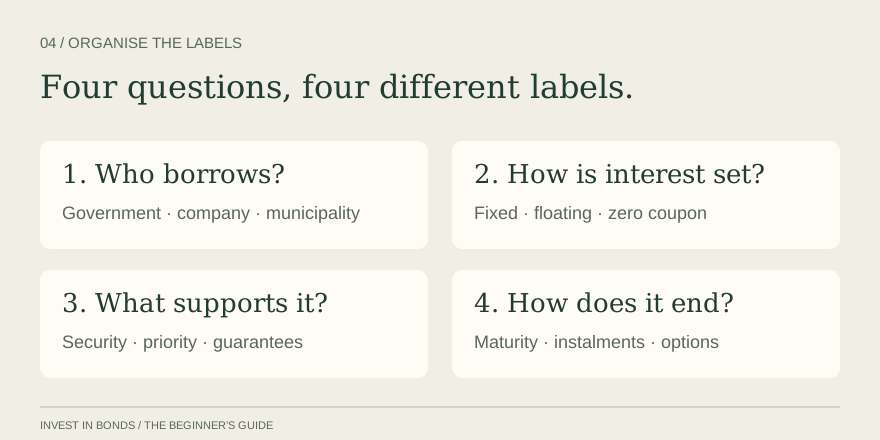 Each row answers a different question. Several labels can apply to the same bond. View full-size diagram
The second drawer: how is the interest determined?
A fixed-rate bond sets the coupon under its terms. A floating-rate bond uses a reference rate and a reset rule, often with a specified spread. To understand a floater, find the benchmark, how often it resets and whether the terms contain a floor, cap or other condition. A variable coupon may reduce one kind of sensitivity while leaving other risks intact.
A zero-coupon structure has no periodic coupon. The investor’s return depends on the purchase amount and the redemption amount, among other factors. “No coupon” does not mean “no return”. It means the payment pattern is different.
For illustration, paying ₹9,600 and receiving ₹10,000 one year later produces ₹400 before costs and taxes, or about 4.17% of the amount paid. That is an invented one-year arithmetic example, not a current Treasury Bill quote. Using shorter periods would require an appropriate annualisation method.
The third drawer: what protections and conditions apply?
Secured and unsecured describe whether specified security supports the obligation. Senior and subordinated describe aspects of payment priority. Callable and puttable describe early-redemption rights. These terms do not rank a whole investment from good to bad on their own.
Imagine two hypothetical bonds from the same issuer. One is secured against specified assets but has a long remaining maturity. The other is unsecured and matures sooner. The label “secured” cannot tell you everything about the collateral, likely recovery, exit price or suitability for a short-term goal. The fuller contract still matters.
Similarly, a call option can change the payment horizon. A coupon that looks attractive for ten years may not remain available for ten years if the issuer has and exercises an earlier call right. Chapter 9 explains how to read those conditions.
Some familiar products need their own drawer
RBI Floating Rate Savings Bonds are a savings-bond product with particular holding and redemption conditions. They should not be treated as interchangeable with an actively quoted government security. Check the product’s own current terms rather than carrying trading assumptions across from another instrument.
Sovereign Gold Bonds link the investment to gold and have scheme-specific interest, redemption and tax rules. They do not give the same economic exposure as an ordinary rupee fixed-coupon bond. A reference to the scheme in an old article does not establish that a new subscription window is open today.
Tax-free bonds and bonds associated with capital-gains relief also deserve careful separation. A tax description concerns a particular treatment subject to conditions. It is not a blanket statement that every receipt or transaction involving the bond is free of tax. Verify the exact instrument and your eligibility.
Green bonds describe a financing purpose or framework. That description does not itself eliminate the issuer’s repayment risk. Read both the use-of-proceeds information and the financial terms.
Keep complex structures out of the fast lane
Perpetual instruments, loss-absorbing bank capital and market-linked debentures require additional analysis. A market-linked payoff can depend on an index or other underlying variable. A bank capital instrument can contain conditions very different from an ordinary deposit or senior bond.
You do not need to begin with every available structure. Recognising that an instrument needs more understanding is a useful skill. If you cannot draw its payment rules, explain its adverse outcomes and identify the relevant documents, it is reasonable to move on.
Make your own classification card
For each bond, answer four questions: Who owes the money? How are payments calculated? What rights and protections apply? When and how can principal come back?
Then add a fifth question: can I actually buy this issue through my chosen route, in a suitable denomination, under current rules? Being able to describe a bond does not establish that it is currently available to you.
Use categories to organise your questions. Use the instrument’s documents to answer them.
You now have enough vocabulary to read a basic listing. The next step is to understand the number that most often catches the eye: the return.