After a first purchase, the temptation is to repeat the transaction that felt comfortable. The issuer is familiar. The platform is already set up. Another bond appears with a slightly higher coupon.
Before repeating the purchase, zoom out. A collection of individually understandable bonds can still form an awkward portfolio.
The next decision should begin with the whole picture: purposes, repayment dates, exposures and the work required to manage them.
Count exposures, not certificates
Five ISINs from one issuer are five instruments but one concentrated borrower exposure. Different issuers within the same group may share dependencies. Several businesses can also be sensitive to the same economic conditions.
List your holdings by legal issuer and connected group, then by business type and maturity period. Include relevant exposure outside the bond list when judging your overall finances. A bond portfolio is not the whole household balance sheet.
Diversification can reduce the impact of a particular concentration, but it cannot make every outcome safe. Buying more instruments without understanding them can also increase the amount of research and administration you need.
Let dates do some of the planning
A maturity ladder spreads scheduled principal repayments across different dates. It can help organise cash needs and avoid having everything mature at once. It does not remove default risk, create guaranteed early liquidity or ensure that reinvestment rates will be attractive.
Consider a fictional ₹90,000 allocation split into three ₹30,000 face amounts, each assumed purchased at par. One matures in a year, one in two years and one in three. Assume ordinary bullet repayment, full payment and no calls. We are illustrating the maturity pattern, not recommending equal allocations or any issuer.
| Scheduled maturity | Principal expected under the example |
|---|---|
| End of year 1 | ₹30,000 |
| End of year 2 | ₹30,000 |
| End of year 3 | ₹30,000 |
At the first maturity, you decide whether the money is needed for spending or can be reinvested. If you extend the ladder, the new instrument must be assessed on current terms. There is no obligation to buy a replacement simply to preserve a diagram.
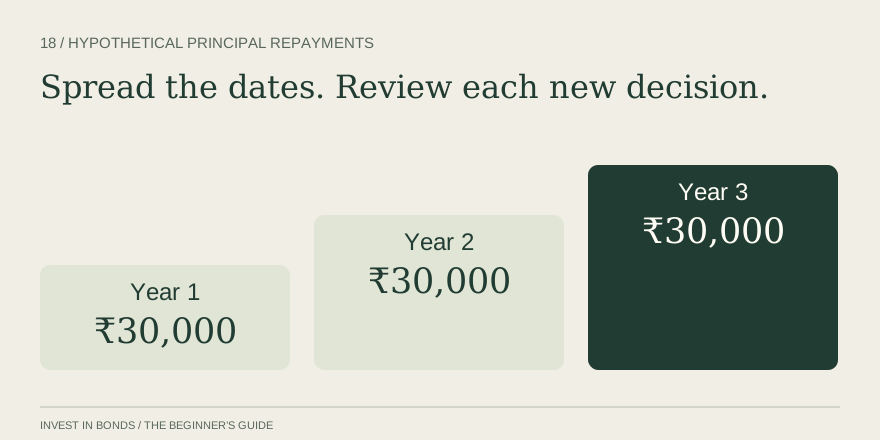 Illustrative maturity ladder. Coupon cash flows are omitted; all principal payments are assumed to occur in full and on time. View full-size diagram
Build an income calendar from actual dates
Different payment frequencies can be combined, but count the actual calendar rather than an average monthly yield. An annual coupon received in December will not pay a September bill unless you have other accessible money.
Use the tracker to view expected receipts alongside planned expenses. Allow for the fact that a bond payment can be delayed and that settlement from a sale may not be immediate. An income plan that works only when every date is perfect deserves another look.
If the administration becomes complicated, compare other structures you understand, including appropriate deposits or pooled debt investments. Complexity is a cost even when it does not appear on an invoice.
Rebalance when the purpose changes
A new job, a major expense or an approaching goal can change what you need from the portfolio. Review the allocation in that context rather than reacting to every movement in market value.
Selling has consequences: an available price, transaction costs, tax and a settlement period. Allowing a bond to mature and directing the proceeds elsewhere can be another route. Neither is automatically right; the choice depends on the facts and the urgency of the change.
Write the reason for the adjustment before making it. “My planned expense has moved forward” is a clearer basis than “this bond looks boring compared with a new offer”.
Recognise the habits that cause avoidable errors
Some mistakes begin before the first purchase: treating coupon as total return, accepting a rating as a guarantee, assuming a call date is maturity, or comparing after-tax and before-tax numbers as though they match.
Others appear later: adding to one group repeatedly, ignoring a changed rating, losing the payment records or treating an app’s valuation as an executable sale price. A checklist works because it makes these easy-to-miss distinctions visible again.
Avoid inventing certainty from a good first experience. One issuer paying one coupon on time does not establish that every future issue is suitable or that a different structure is equally understandable.
Know when help adds value
Seek qualified assistance when the decision involves your overall allocation, a complex payoff, substantial concentration, a tax ambiguity, a default or an unfamiliar legal right. Personalised investment advice should come from an appropriately registered professional; tax and legal questions may require the relevant specialist.
Ask what the professional is responsible for, how they are paid and what the analysis covers. Getting help should make the decision more understandable, not replace one unexplained assurance with another.
Keep a repeatable five-step habit
Start with purpose. Identify the instrument. Check the evidence and terms. Reconcile the purchase. Monitor what you own.
This sequence will not predict every adverse event. It gives you a disciplined way to make decisions with the information available, notice uncertainty and respond when the facts change.
Before your next investment, return to the original sentence from Chapter 1: “I would pay this amount to receive these payments from this borrower, on these dates, subject to these conditions.” Add one more line: “This fits my finances because…”.
If you can complete both in plain language, you are bringing understanding to the decision. If you cannot, you have found the next question to answer.
The aim is to make decisions you understand, keep records you can trust and leave room to change your mind when the facts change.
The workbook that follows turns these ideas into reusable pages. You can use it before a purchase, after a payment, or whenever you want to check that an investment still serves the purpose you gave it.