A bond listing can look like a secret code: a company name, a percentage, a date and a long string beginning with letters. The quickest way to make sense of it is to translate each field into a question about money.
We will use one deliberately simple example. “Example Company” is fictional. Its bond has a ₹10,000 face value, an 8% fixed annual coupon, three years until maturity and repayment of the full face value at the end. It has no call or put option. We assume all payments occur as scheduled. These are teaching assumptions, not terms to expect from every bond.
Who owes you the money?
The issuer is the legal borrower. A trading app, distributor or research website may display the bond without being responsible for its interest or principal. A well-known group’s name is not a substitute for the exact issuing company’s name.
Write the legal name into your research sheet. If the issuer is a subsidiary, identify that fact. If someone says the parent supports it, ask whether the support is a contractual guarantee for this instrument or an expectation. We will investigate that distinction in Chapter 9.
Face value and purchase price
Face value is the nominal amount used in the terms. For our simple example, it is the amount on which the coupon is calculated and the amount due at maturity. The purchase price is what you actually pay for the bond, before or after accrued interest and charges depending on how the quote is presented.
If you pay ₹10,500 for a bond that redeems at ₹10,000, your higher purchase price does not increase the principal the issuer owes you. If you pay ₹9,500, it does not reduce the stated redemption amount. In both cases, the bond’s remaining interest payments and repayment terms still need to be considered.
Some instruments repay principal in stages or have different redemption terms. Always read the schedule rather than treating the simplest example as a universal rule. SEBI’s corporate bond FAQ is a useful starting reference for the terminology.
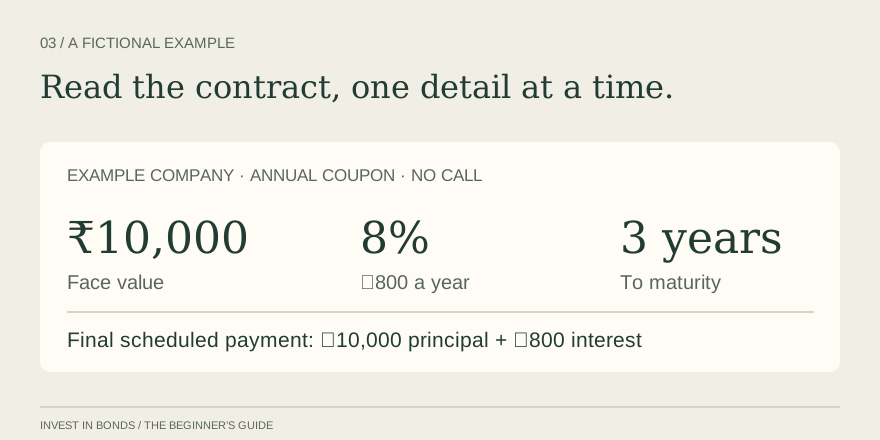 Our recurring example is fictional. Taxes, fees, default and early redemption are excluded unless stated. View full-size diagram
Coupon and payment frequency
The coupon rate tells us how interest is calculated under the contract. For the unchanged ₹10,000 principal in our example, 8% means ₹800 a year.
Frequency tells us when it is paid. If the same annual coupon were split into two equal regular half-year periods, each coupon would be ₹400. That would not mean 8% every six months. Similarly, a monthly payment label does not mean that an advertised annual rate is earned every month.
Actual first or final coupon periods can be shorter or longer than a regular interval. Dates, day-count conventions, business-day adjustments and principal changes can affect the calculation. For a real bond, use the published schedule and verified amounts rather than dividing by twelve and assuming that is the final answer.
Maturity, remaining life and redemption
Maturity is the contractual final repayment date for an ordinary dated bond. Remaining life is the time between your purchase and that date. A bond originally issued for ten years may have only two years left when you encounter it.
Redemption describes repayment under the terms. A bullet bond repays its principal in one payment at maturity. An amortising bond repays principal in instalments. A callable bond gives the issuer specified early-redemption rights; a puttable bond gives the holder specified rights to request repayment. The notice periods and conditions matter.
For a perpetual instrument, a displayed call date is not a substitute for a fixed maturity date. If the issuer does not exercise a call, your holding can continue. Treating the call as a certain exit would put the wrong date into your plan.
ISIN: identify the exact instrument
An International Securities Identification Number, or ISIN, identifies a security. Use it to match a listing with an offer document, rating report and holding statement. One company can have many bonds with different maturities and rights.
Do not rely on a short marketing title when comparing documents. Two nearly identical names can describe different series. Our fictional example intentionally has no invented valid-looking ISIN. When researching a real investment, the real ISIN is one of the first fields to record.
The same discipline applies to a rating. A rating attached to another borrowing by the same issuer is not automatically the rating for the instrument you are considering.
Face value is not the whole minimum investment
A platform may require a minimum number of units or a minimum face amount. The cash needed also depends on the price, accrued interest and charges. A ₹10,000 face-value field does not by itself establish that ₹10,000 is enough to complete a transaction.
For example, two units priced at ₹10,100 each cost ₹20,200 before any additional settlement components. A minimum of two units changes the decision for someone who wanted to invest only ₹10,000. Check denomination, lot size and the final payable amount separately.
Translate the listing
Take a real listing only as a reading exercise. Without making a purchase, try filling in the following statements:
- The legal borrower is… and the exact security is identified by…
- The face amount per unit is… and the offered price is…
- The remaining interest payments are due on…
- Principal is scheduled to be repaid in this way…
- Early repayment can occur under these conditions…
- The minimum order requires this many units and approximately this much cash…
If a field is absent, write “not yet verified”. Leaving a blank visible is more useful than filling it with an assumption. The exercise is complete when you know which document or person can supply the answer, even if you decide not to pursue that particular bond.
Read a bond as a sequence of dated obligations, not as a collection of impressive labels.
Next, we will organise the many kinds of bonds you may encounter. The aim is a usable map, not a vocabulary test.