Imagine three bonds displayed side by side. The first shows 7%, the second 8% and the third 10%. Your eye goes to 10% before you have read anything else.
That is a natural response. It is also the reason to decide your comparison method before opening the offers.
A percentage is one field in a decision. The question is what you must accept to have a chance of earning it.
Compare against your purpose first
Bring back the four lines you wrote in Chapter 2: the job for the money, the date you may need it, the income pattern and the consequence of a delay or loss.
Use these as filters. If the minimum order is too large, the payment dates do not fit, or the structure is outside what you understand, there is no need to spend an hour comparing the yield. Excluding an instrument early is a useful result.
Consider a hypothetical goal eighteen months away. A five-year bond may be sellable before then, but choosing it would add an uncertain exit price to your plan. The maturity mismatch is real even if the borrower is well known.
Make the price basis consistent
Check that the numbers refer to the same date and price convention. Is the displayed rate a coupon, current yield, YTM or yield to call? Does the final price include accrued interest? Does the yield include charges? What quantity can actually be purchased?
If one platform supplies a quote from today and another displays a historical trade, you are not comparing two simultaneously available transactions. If one yield assumes an early call and another assumes final maturity, the horizons differ.
The NSE yield calculator illustrates why cash-flow dates and conventions belong in the calculation. Precision to two decimal places does not make incompatible inputs comparable.
Use a deliberately incomplete example
The following options are fictional. The yields are assumed comparison inputs, not calculations or current offers. Their purpose is to show what a yield ranking leaves out.
| Question | Bond A | Bond B | Bond C |
|---|---|---|---|
| Assumed quoted annual yield | 7% | 8% | 10% |
| Remaining term | 1 year | 3 years | 5 years |
| Coupon payments | Half-yearly | Annual | Monthly |
| Early issuer call | None in example | None in example | Allowed after year 2 |
| Current exit evidence | Quote still needs checking | Recent trades only | No current bid found |
| Issuer research | Incomplete | Incomplete | Incomplete |
You cannot choose a winner from this table. The issuer research is unfinished, the exit evidence differs and your goal has not been specified. Monthly payments do not establish greater safety. Bond C’s larger assumed yield does not explain the credit risk or the probability of holding it for five years.
The responsible next step is to fill the missing information or remove the option, not to convert the table into an invented safety score.
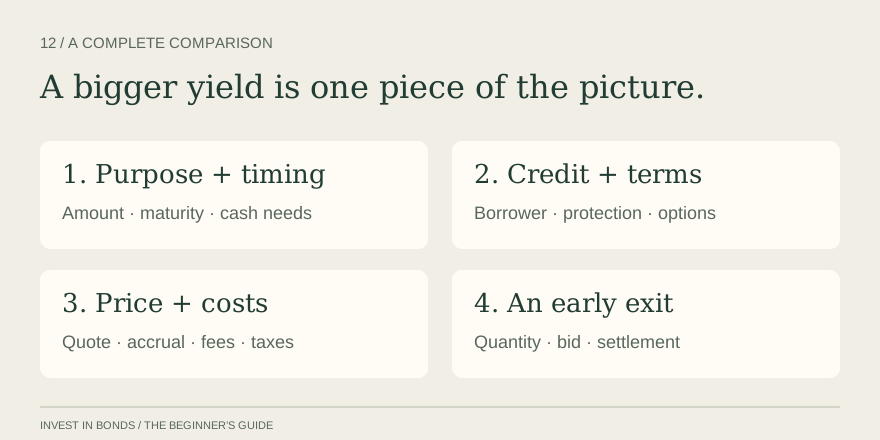 Compare the complete investment against a defined purpose. View full-size diagram
Put related risks beside each other
Compare legal issuer and group exposure, current rating and date, repayment analysis, security and priority, options, maturity, payment pattern, market liquidity and after-cost cash flows.
Read the rating rationale rather than assigning a universal score to a badge. A secured lower-rated bond and an unsecured higher-rated bond cannot be ordered reliably by adding arbitrary points for the words “secured” and “rated”. Their risks depend on the underlying facts.
Likewise, do not compare a bank deposit’s terms with a bond’s coupon while ignoring early access, insurance treatment, price and tax. Bring the differences into the table explicitly.
Translate an extra yield into rupees
Suppose two hypothetical one-year investments each require ₹20,000 and, under deliberately simplified assumptions, offer returns differing by one percentage point. The difference is ₹200 before tax and costs.
Now consider what you would be accepting for that additional amount. A longer term, less liquidity or a more difficult credit assessment might still be acceptable to a particular investor—but the decision looks clearer when the reward is expressed in rupees alongside the possible consequences.
Do not extend this simple calculation to bonds with different prices, maturities or payment patterns without adjusting the cash flows. Its purpose is perspective, not a substitute for a yield calculation.
Test a less comfortable outcome
Ask how the comparison changes if you must sell early, a coupon arrives late, or a callable bond is redeemed at the first allowed date. You do not need to forecast each event. You need to see whether the preferred option still fits your constraints when the favourable assumption is removed.
For the five-year fictional Bond C, write two timelines: called after year two and not called. If only one timeline works for your plan, you have identified an important dependency. That belongs in the decision note.
Make a decision you can explain
A useful conclusion sounds like this: “This instrument fits the amount and repayment date I planned. I understand its obligations and the risks I would retain. I have checked the source documents and the final quote.”
It can also sound like this: “None of the current options fits the purpose at a price and level of risk I understand.” Waiting does not create a failed comparison. It can be the clearest output of the comparison.
Choose a complete set of terms you can live with, not the largest number on the screen.
Your comparison exercise
Use the workbook to place two actual instruments side by side as a research exercise. Mark each cell “verified”, “needs checking” or “not applicable”. Avoid assigning a numerical overall score. Instead, write the three facts that matter most for your purpose and the questions that remain.
When the comparison is complete, you are ready to understand the route through which a purchase would happen.