Two offers say “secured”. One is backed by clearly identified assets with a documented charge. The other gives you only the word in a colourful badge. You do not yet have enough information to treat them alike.
The small print is where broad descriptions become specific rights. Reading it is less about understanding every legal phrase than about finding the provisions that could change your payments or your recovery.
Ask what secures the debt
For a secured bond, identify the assets, the nature and rank of the charge, other claims on those assets and the monitoring arrangements. An asset-cover figure can be useful, but it needs a valuation date and an explanation of what is counted.
In a fictional example, an issuer says ₹15,000 of assets support ₹10,000 of debt. That does not mean an investor is certain to recover ₹10,000. The assets might sell for less than the reported value, several creditors might have claims, and enforcement can take time and money. Security affects the recovery analysis; it does not turn it into arithmetic based on one headline ratio.
Ask how the assets relate to the business. Cash receivables, land and specialised equipment have different characteristics. If the same conditions that harm the borrower also reduce the value of its collateral, both parts of the investment can weaken together.
Priority is a relationship between claims
Senior and subordinated describe where an obligation stands relative to other claims under its terms and applicable law. To understand the label, ask “senior to what?” and “subordinated to whom?”
A simplified diagram can help you visualise that some claims stand ahead of others. It cannot establish the actual distribution in a bankruptcy, bank resolution or enforcement process. Security interests, statutory claims, the type of entity and instrument-specific provisions can all matter.
For your notes, record the exact ranking language and the document location. If that language is too complex to interpret reliably, seek qualified help or leave the instrument outside your shortlist. A beginner does not have to solve a complicated capital structure to find a useful learning opportunity.
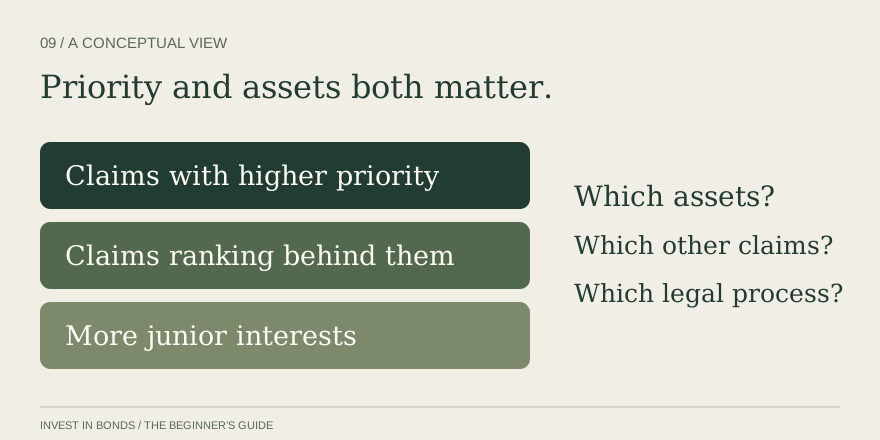 Conceptual illustration only. The actual ranking depends on the contract, entity and applicable law. View full-size diagram
A guarantee needs a guarantor and a scope
A statement that an issuer belongs to a respected group does not identify an enforceable guarantee. Find the guarantor, covered obligations, limits, conditions and duration. Check whether the guarantee covers interest, principal or something narrower.
Then ask whether the guarantor can meet the obligation. A guarantee from an entity exposed to the same financial strain may offer less protection than a casual description suggests. “Supported by” is a phrase to investigate, not a replacement for the guarantee document.
Use the same discipline for government-related issuers. Ownership, an expectation of support and an explicit guarantee are different facts. Write down the fact you can establish rather than the reassuring interpretation you would prefer.
The trustee is part of the structure
A debenture trustee has defined responsibilities connected with the issue and investor interests. Monitoring security and dealing with certain grievances form part of the framework described in SEBI’s trustee investor charter.
Find the trustee’s name and official contact details in the issue documents. Keep them in your records. Appointment of a trustee does not make the trustee the borrower or create a general promise that the trustee will repay your investment from its own funds.
For the same reason, a timetable for responding to a complaint is not a timetable guaranteeing recovery after default. Distinguish a service obligation from an investment outcome.
Who controls early repayment?
A call option gives the issuer rights to redeem under specified conditions. A put option gives the holder specified rights to seek redemption. Neither should be understood without the eligible dates, prices, notice requirements and other conditions.
Imagine a hypothetical bond with a stated final maturity in ten years and an issuer call after five. If you assume five years in your income plan, ask what happens if the call is not exercised. If you assume ten years, ask what happens if it is. One printed maturity number does not answer both scenarios.
The call price can also differ from what you paid. Paying a premium immediately before a possible call needs particular attention. Model the contractual call payment rather than assuming your purchase cost will be returned.
Understand clauses that change the cash flows
Covenants are promises or restrictions in the agreement. They may relate to financial conditions, reporting, security or actions the issuer can take. Find what constitutes a breach, how it is addressed and who can act. A covenant helps only to the extent that its wording, monitoring and remedies provide the protection you think it does.
Also check for principal repayment in instalments, floating-rate resets, coupon deferral, conversion and write-down provisions. These features can change the timeline you drew earlier. If the timeline no longer fits on the simple example card, redraw it rather than forcing the bond into a familiar shape.
Bank capital requires a different level of understanding
Additional Tier 1 bank instruments can be perpetual, allow coupon cancellation and absorb losses through contractual and regulatory mechanisms. RBI’s capital-adequacy directions, updated in July 2026, set out these features. A call date does not create a promise of repayment on that date.
This is enough to establish the beginner’s decision rule: do not treat bank capital as an ordinary fixed deposit or plain senior bond. Learn the actual loss-absorption terms before considering it. A high coupon does not compensate for a mechanism you have not understood.
Market-linked debentures also need a separate payoff analysis. A principal-protection description can still depend on issuer solvency and contractual conditions. Draw both favourable and adverse scenarios rather than relying on the product name.
The most useful clause is often the one that tells you when the outcome can differ from the headline.
Your document-reading exercise
Find the sections for repayment, security, ranking, options, events of default and trustee details. Write a short explanation of each in your own words. Do not copy a paragraph you cannot explain. A clear “I need this clarified” is a better research result than a folder full of unread documents.