Imagine planning to pay a bill from a bond’s interest. Now imagine three different problems: the issuer pays late, you need the money earlier than expected, or the interest arrives on time but buys less than it used to.
Each is a different risk. Calling the bond simply “safe” or “risky” hides the distinction.
A useful risk assessment names the event, follows its effect on your money and asks whether your plan can cope. SEBI’s bond guide identifies default, interest-rate, liquidity and call risks. We will translate these ideas into decisions you can make before buying.
The borrower may not pay as expected
Credit risk concerns the issuer’s ability and willingness to meet its obligations. Payments can be delayed, reduced or missed. A promise to repay ₹10,000 is not the same thing as ₹10,000 already available in your bank account.
In a hypothetical severe outcome, you invest ₹10,000, receive one ₹800 coupon and ultimately recover only ₹6,000 of principal. Total receipts of ₹6,800 are below the original investment even before considering the time involved, tax or costs. The original 8% coupon has not protected you from a loss.
This example is invented to show the arithmetic, not to predict a recovery rate. Actual recoveries depend on the instrument, available assets, other claims and the resolution process. They may be small, delayed or absent. A higher promised coupon should therefore prompt a question about the risks behind it.
You may need an exit that is not available
Liquidity is about the ability to transact in the quantity you need at an acceptable price and time. An exchange listing establishes a place or framework for trading; it does not create a buyer for every holding at every moment.
Suppose you bought at ₹10,000 and later need cash urgently. A displayed valuation is ₹10,050, but the only available bid for your quantity is ₹9,700. Your practical choice concerns the executable bid and the settlement process, not the more comfortable screen value.
Ask how the sale would be arranged before buying. Is there an order book, a quote request, or a dealer-assisted process? What evidence is available about recent activity? A statement that the platform will “help you sell” is not the same as a contractual commitment to buy at a known price.
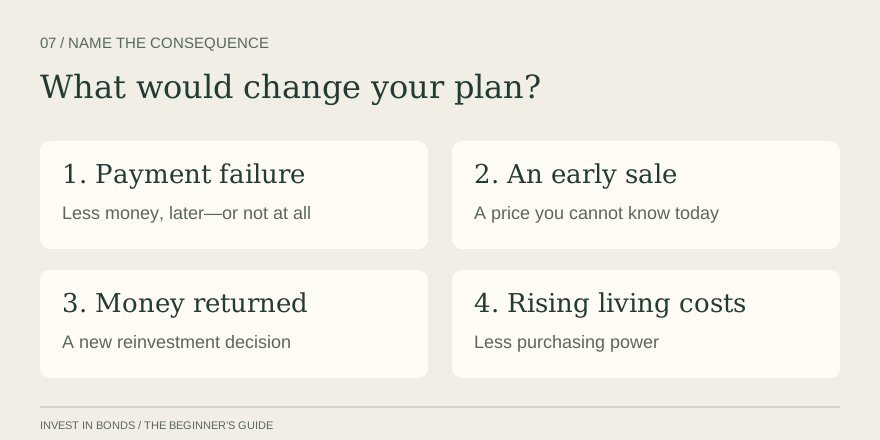 Risk is easier to assess when you connect an event to the money you need. View full-size diagram
Market prices can move against your timing
Interest-rate risk matters particularly when the value of a fixed payment schedule changes and you need to sell. Chapter 6 explained the inverse relationship between price and yield. Longer exposure and different cash-flow structures can create different sensitivities.
Credit concerns can also push a required yield higher and a price lower, even if general government-bond yields are unchanged. A falling price is therefore not automatically a harmless interest-rate movement. Investigate the source of the change.
Money coming back can create a new problem
Reinvestment risk appears when you receive money and cannot place it again on the terms you expected. Coupons arrive during the holding period. Principal may return at maturity or earlier under a call or repayment provision.
Imagine you budgeted on earning a particular rate for several years, but a bond is called at an allowed date. You receive the contractual call payment, yet the next available investments may pay less. The borrower may have honoured the agreement while your income plan still needs adjusting.
Do not solve that gap by automatically reaching for a riskier borrower. Reassess the purpose and the available choices. An old rate does not become a requirement that the market must satisfy.
Inflation changes the meaning of a rupee
Nominal return counts rupees. Real return considers purchasing power. If an investment’s after-tax return is lower than inflation over the same period, the money can buy less even though the balance has increased.
As a hypothetical one-year example, a 5% after-tax return alongside 6% inflation gives a real return of approximately 1.05 ÷ 1.06 − 1, or minus 0.94%. These are teaching assumptions, not inflation or investment forecasts. The formula shows why a positive nominal number can coexist with a reduction in purchasing power.
Several names may hide one concentration
Buying five bonds is not automatically diversification. They may be obligations of the same company, members of one corporate group, or businesses exposed to the same source of stress. Similar maturity dates can also concentrate the need to reinvest.
Start by listing exposure by legal issuer, connected group and business type. If one event could affect several holdings together, count that possibility in your assessment. The appropriate allocation depends on your wider finances; a beginner’s guide should not invent a universal safe percentage.
Operational mistakes are risks too
You can choose a legitimate security and still make a harmful payment mistake. A mistyped account, an impersonated website, a wrong ISIN or a misunderstood quantity can derail the transaction. Slow down at the final confirmation screen and compare it with your research notes.
Keep the official route bookmarked, use the platform’s authenticated payment instructions and check holdings after settlement. Do not share passwords or OTPs with someone offering to complete the purchase for you.
Make a small stress table
For your proposed investment, write three rows: “payment arrives late”, “I need to sell early”, and “reinvestment rates are lower”. Beside each, write the practical consequence and the resources you would have available.
If the consequence is an essential bill you cannot meet, that is a constraint worth addressing before investing. If the answer is “I do not know what would happen”, identify the missing term or process.
Risk management begins with a question you can answer before the difficult event occurs.
A rating can help with one part of this work. It cannot answer the entire table. That is the subject of the next chapter.