You buy a bond and check its displayed value a week later. It has fallen. No payment has been missed. The issuer has not announced a problem. How can a fixed-rate investment have a changing price?
Because the fixed part is the coupon formula. Other investors are continuously deciding what they would pay for the remaining payments.
A familiar comparison
Imagine two otherwise identical hypothetical bonds. Both repay ₹10,000 in one year. One promises ₹800 of interest; the other promises ₹900. Assume the same payment risk and no costs or taxes.
If both cost ₹10,000, the higher payment would be more attractive. To compete, the bond paying ₹800 would have to be available at a different price. The contract can stay unchanged while the price does the adjusting.
This comparison is intentionally controlled: only the payments differ. In the real world, issuers, liquidity, settlement and contractual features may differ too. Do not attribute every price gap to interest rates.
The inverse relationship
For fixed promised cash flows, a higher required yield produces a lower present value. A lower required yield produces a higher present value. That is the mathematical price–yield relationship described in the RBI’s government securities primer.
Return to our example with ₹800 annual coupons and ₹10,000 repayment after three years. Hold the payment schedule constant and change only the discount rate:
| Required annual yield | Calculated price |
|---|---|
| 7% | ₹10,262.43 |
| 8% | ₹10,000.00 |
| 9% | ₹9,746.87 |
These prices come from discounting each payment to today. They assume three complete annual periods, no accrued interest, no optionality and full payment. They are not forecasts of where a real bond will trade.
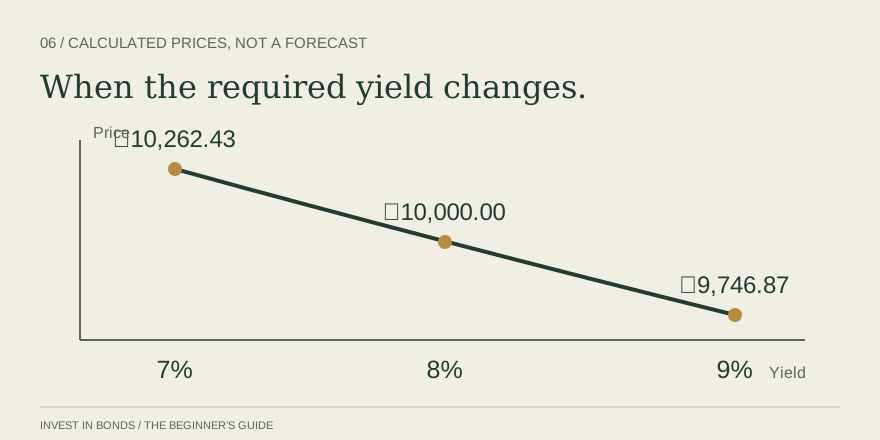 Calculated from the guide’s hypothetical three-year, 8% annual-pay bond. All other assumptions are unchanged. View full-size diagram
A policy rate is not every bond’s yield
You may hear that the RBI changed a policy rate and wonder what that means for your bond. Market yields reflect expectations, the timing of payments, credit conditions, liquidity and other factors. A policy announcement is one input, not a mechanical instruction for every bond price to move by the same amount.
Some expectations may already be reflected in prices before an announcement. Different maturities can react differently. The practical lesson is to avoid turning a headline into a guaranteed trading rule.
If your plan needs a particular price gain after a rate decision, you are relying on a market outcome beyond the contractual cash flows. Recognise that as a separate assumption.
Time changes the sensitivity
A payment far in the future is discounted over more periods than a payment next month. All else equal, that often makes a longer-dated fixed-rate bond more sensitive to a change in required yield. Coupon size and the timing of principal repayments also affect sensitivity.
Duration summarises aspects of that timing. Modified duration is commonly used to estimate the percentage price change for a small yield change. It is not the same as maturity. A bond that pays coupons before maturity returns some cash sooner than one that pays everything at the end.
Here is a purely illustrative approximation. A bond with modified duration of 4 might fall by roughly 4% if its yield rises by one percentage point, all else equal. That uses the relationship “percentage price change ≈ minus modified duration × yield change”, with the yield change written as 0.01. It is an approximation, not an exact promise; curvature, larger changes and embedded options can make it less accurate.
You do not need to become a duration trader to use this knowledge. You need to understand that two bonds with similar yields can expose your savings to different price movements.
What if you hold to maturity?
If a plain bond makes all its scheduled payments and you hold it to contractual maturity, interim market prices do not change those promised receipts. But that sentence contains conditions. The issuer must pay, early-redemption features must be understood, and you must actually be able to keep holding.
Holding also does not erase the purchase price. Someone who paid ₹10,500 for ₹10,000 redemption still paid a premium. Nor does it remove the opportunity cost of being committed to one set of payments while new opportunities change.
The phrase “I will hold to maturity” is therefore a useful plan only when it fits your cash needs and the instrument’s actual terms. It should not become a way of dismissing every risk.
A displayed value is not necessarily an exit quote
Your account may show a market value based on a recent trade or a valuation. That number may not be an executable bid for the quantity you want to sell. A last-traded price from a small or old transaction is different from a current offer to buy your holding.
If you need to exit, ask what amount you would actually receive after the spread and charges, when settlement would occur and whether the quote is firm. That is more useful than debating a valuation change without a trading route.
Use the movement as a question
When a price changes, ask what information changed. Has the general yield environment moved? Has the issuer’s credit position changed? Is the price based on a stale or unusual trade? Are different sources using clean and dirty prices? You do not have to find an instant explanation for every tick, but you should avoid confusing these causes.
A bond can keep the same payment promise while the market changes its opinion of today’s price.
A minute to think
If market yields rise while our fixed ₹800 coupons remain unchanged, which way should the calculated price move, all else equal? Down. Does that prove that selling today is right for you? No. Your goal, time horizon, credit assessment and available quote are still part of the decision. Next, we put those risks into practical scenarios.