Finding a bond on a website is the beginning of a journey. Placing an order is another step. Owning the security after settlement is another. The same organisation does not necessarily perform all three jobs.
Understanding the route helps you know whose details to check, where the money should go and what evidence to expect afterwards.
Two markets, different starting points
In a primary issue, the issuer raises money through a new offering. Your application is subject to the issue’s eligibility, process and allotment rules. An application does not guarantee that you will receive the amount requested.
In the secondary market, an existing holder or dealer sells a security. You assess the remaining terms and the offered price. Availability, quantity and the settlement process matter. The money paid for the security normally goes to the selling counterparty through the relevant transaction arrangements, rather than becoming a fresh loan directly to the issuer.
This distinction also explains why an original issue price is not necessarily the price you can obtain now.
Government securities through Retail Direct
RBI Retail Direct enables individuals to hold an RDG account and access eligible government securities through primary and secondary routes. RDG means Retail Direct Gilt. These holdings are distinct from securities held in an ordinary NSDL or CDSL demat account. The RBI FAQ explains the account and custody structure.
For a beginner, the useful comparison is practical: which securities can you access, how do orders work, what are the current minimums, and how do you view holdings and receive payments? Some government securities can also be accessed through other eligible intermediaries. Check the route rather than assuming every broker supports every instrument or feature.
The Retail Direct portal also contains product-specific facilities. Do not assume that a savings bond and a traded security use identical exit procedures simply because they appear within one service.
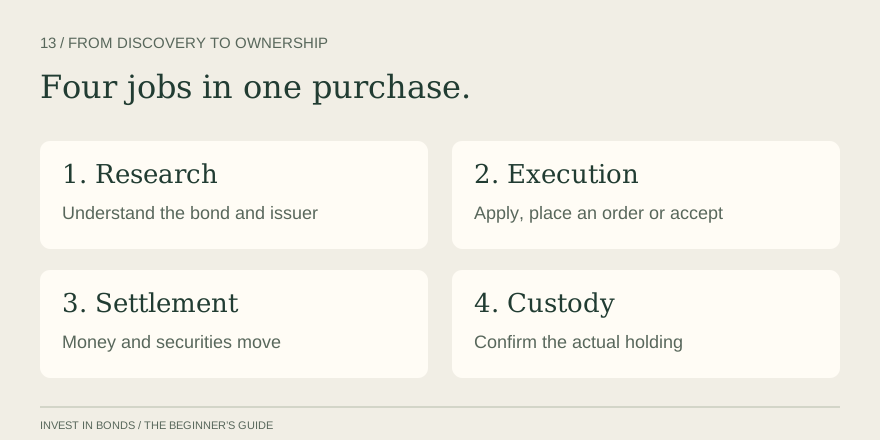 Research, execution and custody are separate parts of the investment journey. View full-size diagram
Corporate bonds through eligible intermediaries
Brokers and online bond platforms can provide access to different parts of the corporate bond market. An Online Bond Platform Provider, or OBPP, operates within a specific registration framework. Start with SEBI’s page linking to the NSE and BSE lists and match the legal entity, not just a trading brand.
Registration is a verification step. It does not guarantee the investment, establish that every item promoted elsewhere by a group has the same regulatory treatment, or make a bond suitable for you.
Compare the route’s documentation, price transparency, charges, supported order sizes, custody arrangements, exit process and customer support. You do not need a “best platform” ranking to ask these questions. A clear explanation of what happens to your order is more valuable than a colourful list of benefits.
What is a quote request?
Some bond trading involves asking for a quote rather than clicking on a continuously available order-book price. A Request for Quote, or RFQ, is a mechanism for requesting and agreeing transaction terms. NSE’s RFQ FAQ describes access through eligible trading members for retail participants.
A quote can have a quantity, validity period and settlement condition. Before accepting it, check whether the displayed yield is based on that actual quote and whether the total payable amount matches your understanding. If the quote changes, repeat the comparison. A previous screenshot does not lock in a trade unless the agreed process establishes that it does.
Know who does what
The issuer owes the contractual payments. The intermediary facilitates access or execution according to its role. Exchanges and clearing arrangements support relevant market and settlement functions. A depository records dematerialised securities through the account structure. A registrar and trustee have other defined responsibilities.
You do not need to learn the whole market’s organisation chart. You do need to know which entity to approach when an order is unfilled, a holding is missing or an issuer payment is late. These are different problems.
Keep the official contact details with your transaction records. A support number in a forwarded message should not be the only route you have.
Verify the destination of both money and securities
Before funding an order, confirm the official payment route inside the authenticated service. Read the beneficiary and purpose. Do not send money to an individual merely because they claim to represent a registered platform.
Then confirm where the security should appear after settlement. For dematerialised holdings, an independent statement from your depository or participant helps reconcile the platform’s display. NSDL’s explanation of CAS describes the consolidated account statement. Retail Direct holdings should be checked through the relevant RDG records.
Avoid the reassuring shortcut “the money went through, so everything is complete”. A transaction can be pending, partially filled, rejected or awaiting settlement. The status and records tell you which.
Choose a route you can operate confidently
Imagine you needed help selling or correcting an account detail. Could you find the instructions and official support channel? Could you download your records? Could you explain the charges and payment flow to another person?
If the answers are unclear, investigate before placing the first order. Ease of buying is only one part of a usable investment service.
Choose the investment and verify the route. Neither task replaces the other.
The next chapter gathers the preparations that should be complete before your first purchase. It is deliberately a pause between understanding the market and sending money into it.