Picture two envelopes. One contains money for a course beginning in six months. The other contains savings you do not expect to use for several years.
The rupees are identical. Their jobs are different.
A bond that seems reasonable for the second envelope may be awkward for the first. The attractive interest rate has not changed. Your need for the money has.
Begin with the date
Write down what the money is for and when you may need it. Be specific enough to make the answer useful. “For the future” is difficult to evaluate. “For a payment due next June, with little flexibility” gives you something concrete to compare against a bond’s repayment schedule.
Next, ask whether the date could move forward. A planned purchase may be postponed; an emergency often cannot. If you might need the money suddenly, the ability to access it matters alongside the return. Selling a bond requires an available route and an acceptable buyer or quote. You cannot assume that a listed investment turns into spendable cash whenever you choose.
This is why an investment decision starts with your circumstances. SEBI’s overview of asset classes connects investment choices with goals, time horizon and risk tolerance. There is no single percentage allocation in this guide that suits every household.
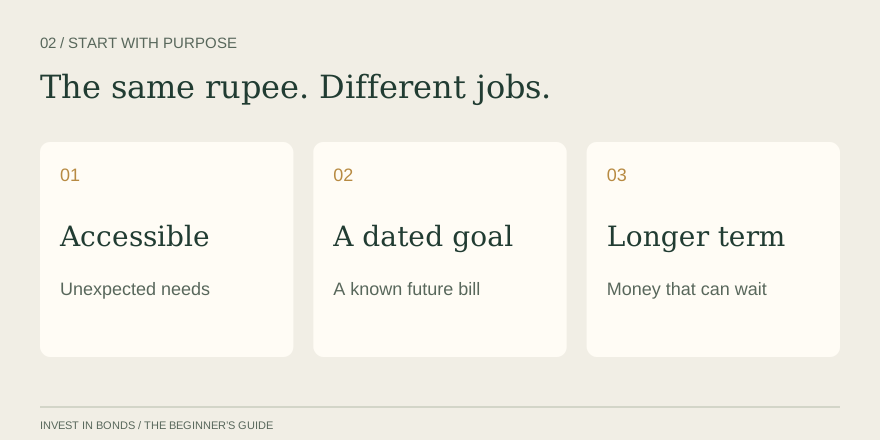 Give each pool of money a purpose before choosing its investment. View full-size diagram
Income is a cash-flow question
Some investors want payments to spend. Others want their savings to accumulate. A bond with annual interest might fit one person’s plan and leave another person waiting for cash they need each month.
Return to our hypothetical ₹10,000 bond paying ₹800 annually. Dividing ₹800 by twelve gives about ₹66.67. That arithmetic does not turn an annual payment into twelve monthly credits. A household budgeting from the bond needs to manage the actual payment date.
If you do not need the interest for spending, you face another decision: what will you do with each payment? Leaving it idle, reinvesting it and spending it create different outcomes. A payment pattern that looks convenient on a product page may create work you have not yet considered.
Bonds, bank deposits, shares and debt funds
These products can all appear in a conversation about saving or investing, but they do not give you the same relationship with your money.
| Investment | What you hold | A useful question |
|---|---|---|
| Bank fixed deposit | A deposit with the bank, under its deposit terms | What are the withdrawal conditions and applicable deposit protection? |
| Individual bond | A claim under one security’s terms | Can this issuer meet these payments, and can I manage the holding period? |
| Equity share | An ownership interest in a company | Can I accept uncertain profits, dividends and market prices? |
| Debt mutual fund | Units in a managed portfolio | What securities and risks does the scheme hold, and how can its unit value change? |
An individual bond and a debt fund deserve particular attention. In the first, you follow an instrument’s cash flows. In the second, you own units in a portfolio with its own expenses, investment policy and valuation. The securities inside the fund can mature without your units automatically paying you a fixed maturity amount. Some schemes follow target-maturity strategies, but that label still needs to be read with the scheme documents.
A fund can offer a different way to spread exposure and manage transactions. It does not remove credit, interest-rate or liquidity risk. The comparison is about the structure you understand and can manage, as well as the cost.
A bank name does not make everything a deposit
You may recognise the same institution on a savings account, a fixed deposit and a bond. Check what the product legally is. A bank-issued bond is not covered simply because the bank’s eligible deposits have deposit insurance.
DICGC’s current FAQ describes cover up to ₹5 lakh for principal and interest of eligible deposits per depositor per bank in the same right and capacity, with aggregation rules and exceptions. That is a deposit-insurance framework, not a general guarantee of securities carrying a bank’s name.
For a beginner, the practical habit is simple: read the product category before transferring the trust you have in a familiar brand to an unfamiliar instrument.
Decide what loss would mean
“I do not like risk” is understandable, but incomplete. Try asking what a loss would do to the job you assigned the money.
Would a delay force you to borrow? Would selling for less than you paid prevent an essential payment? Would you be comfortable investigating a downgrade, or would you need someone qualified to help? These questions distinguish emotional discomfort from a financial constraint.
Consider a hypothetical investor with ₹50,000 reserved for a near-term obligation. A ₹5,000 shortfall is ten per cent of the reserve. It is also a missing ₹5,000 on a bill. Looking at the rupee impact can make a risk much clearer than looking at a percentage in isolation.
Do not borrow to create a first-investment experiment. An investment learning exercise becomes much more complicated when it also has an interest bill and a repayment deadline of its own.
It is acceptable to wait
A successful first decision can be to postpone buying. Perhaps the available denomination is too large for your planned allocation. Perhaps you need more accessible reserves, or the instrument’s risks are still unclear. You do not need to buy a bond to prove that you have understood bonds.
The purpose of this guide is to make you a better decision-maker. It is not a countdown to a transaction.
A return is useful only if the investment can serve the purpose you gave the money.
Put it on paper
Complete four lines: “This money is for…”, “I may need it by…”, “I need income at these intervals…”, and “If payments are delayed or I lose money, the consequence is…”.
Keep those answers beside your research. They will help you reject unsuitable options before you become attached to an appealing yield. In the next chapter, we turn a bond’s details into a readable payment agreement.