Your first government-security purchase should end with a verified holding, not with a celebratory payment screen.
This walkthrough explains RBI Retail Direct using public documentation checked for this edition. Screen names, available securities, limits and funding options can change. Follow the current instructions inside the official portal.
Start at the official service
Reach the service through the RBI’s Retail Direct information page and the official Retail Direct portal. Complete the account-opening and KYC process before trying to fund an investment. Review the linked bank details and nomination information.
RBI’s FAQ explains that an RDG account holds eligible government securities and supports primary and secondary access. The FAQ includes some values explicitly dated to 2021. Use those explanations to understand the process, then confirm current operational details in the portal rather than assuming every old figure still applies.
Choose the security before the order type
Identify whether you are considering a Treasury Bill, a dated central-government security or an SDL. Check the issuer, ISIN, maturity and payment structure. A Treasury Bill has a different cash-flow pattern from a coupon-paying security.
Write down your intended face amount and the maximum cash you can commit. If your goal has a fixed date, compare it with the actual repayment date. Government credit quality does not remove the need to match the investment to your cash needs.
Read the relevant auction announcement or secondary-market information. Do not choose a security solely because it appears first in the list or carries the highest coupon.
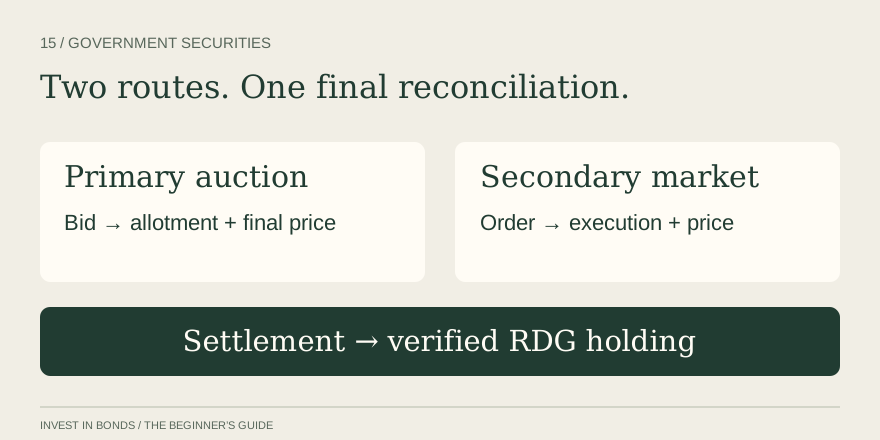 A process map, not a live screen or a promise of allotment. View full-size diagram
Route one: a primary auction
For the non-competitive retail route described by RBI, you submit the amount you wish to invest within the applicable rules rather than bidding your own competitive yield or price. The final allotment price follows the auction process. It is not necessarily the face value or a number you select yourself.
Follow this sequence:
- Open the current auction and verify the security and dates.
- Review the permitted quantity, funding requirement and cutoff.
- Enter the intended amount and check the summary carefully.
- Authorise funding only through the portal’s supported official route.
- Retain the bid acknowledgement and check its status.
- After the auction, review allotment, price, settlement and any refund or release of excess funds.
Funding an application does not eliminate allotment conditions. Follow the status rather than assuming that the requested quantity will definitely become a holding.
Understand the funding buffer
The amount needed before final auction pricing can include components such as accrued interest and a markup or buffer, depending on the security and process. RBI distinguishes the auction funding markup from a fee. Reconcile the final allotment amount and the treatment of any excess using the actual advice.
Here is a deliberately hypothetical reconciliation. You provide ₹10,300. The final allotment amount is ₹10,140 and no other adjustment applies. The difference is ₹160. You would check the official record showing how and when that difference is refunded or released. The figures and timing are not current auction terms.
If the amounts do not reconcile, ask support before repeating the payment. A second transfer can create a second problem rather than solving the first.
Route two: the secondary market
In a secondary purchase, you are assessing an existing security at a market price. Check the exact ISIN, remaining coupon schedule, price basis, quantity, accrued interest and settlement terms.
The Retail Direct service provides access to secondary trading through its designated facilities. The official mobile-app note describes access to primary and NDS-OM Retail services. Use the current interface and help material for the precise steps rather than trying to reproduce an old screenshot.
Before confirming an order or accepting a quote, compare the final payable amount with your notes. A quoted yield is tied to the price and settlement assumptions. If the price changes, check the calculation again.
Know the difference between an order entered and a trade executed. An unfilled or partly filled order does not create the full intended holding. Do not assume an order has disappeared or completed solely because a screen has changed.
Check settlement independently of payment
After the stated settlement date, verify the ISIN and quantity in your RDG holdings and keep the transaction record. Match the bank debit with the final transaction amount. If a primary bid was partly allotted, the held quantity may differ from the original request.
If the security has not appeared when expected, use the official help route with the transaction reference. Keep the issue specific: account, ISIN, amount, date, reference and the discrepancy. Avoid sending unnecessary identity or account information through informal channels.
Put the first receipt on your calendar
For a coupon-bearing security, record the next payment date and expected amount using the verified schedule. For a Treasury Bill, record redemption. Check the designated bank account and retain the payment evidence when the money arrives.
If you bought partway through an interest period, remember the accrued-interest amount paid at purchase when assessing your economic return. The next full coupon is not automatically interest earned only during your holding period.
Plan the exit without promising yourself a price
Holding to maturity and selling early are different paths. If you intend to sell, use the available market route and check the executable quote and settlement. A government security can have a market price below your purchase cost before maturity.
You can write “intended hold to maturity” in your plan while also recording how you would sell in an emergency. The second note does not weaken the first; it makes the plan more complete.
The purchase is complete when the records, money movement and security holding agree.
Your first government-security transaction is now a repeatable process: identify, verify, order, reconcile and monitor. Corporate bonds add a different set of issue and credit details, which we address next.