You see a bond with a prominent rating badge. It looks reassuring. A few letters seem to have compressed a large amount of research into something you can understand at a glance.
That convenience is useful—and easy to overextend. Before letting the badge decide for you, open the report behind it.
What the opinion covers
A credit rating is an agency’s opinion about repayment of a rated obligation. It is not a buy, hold or sell instruction. It also does not settle questions such as whether a quoted price is attractive, whether you can sell tomorrow or whether the bond fits your finances. SEBI’s March 2026 FAQ makes these distinctions explicitly.
That gives you a way to use a rating well: treat it as a researched input to the credit question, then keep the other questions open. You are not rejecting the agency’s work by asking about liquidity or time horizon. You are asking about things outside the conclusion you were shown.
Read the complete identity
A useful rating record has several connected pieces: the exact instrument or programme, the agency, the symbol, any outlook or watch, and the publication date. A screenshot showing only “AA” is an incomplete research note.
Check the report’s instrument table. Does it include the issue you are considering? Does it cover an issuer rating, bank facility, deposit programme or a different debt series? If you cannot match the ISIN directly, ask the agency or issuer’s official documentation to establish the link. Do not solve the uncertainty by assuming that all borrowing by the company has the same rating.
An issuer can have instruments with different priority, support or structure. A familiar name above the table does not make every row interchangeable.
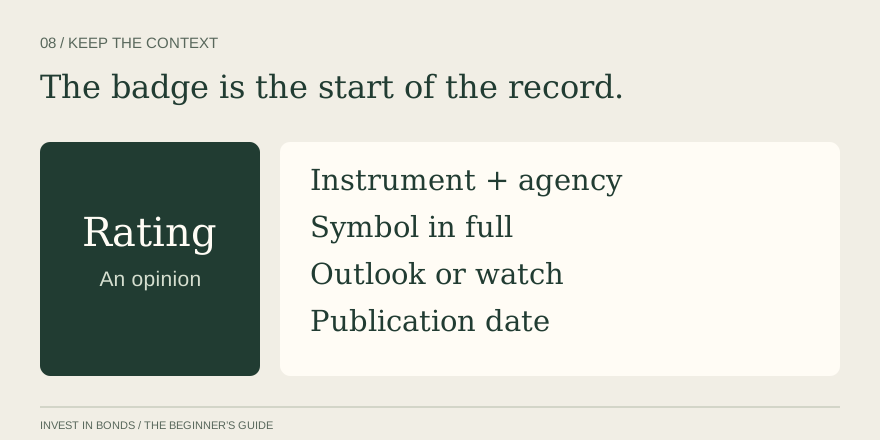 Keep the full record together. The illustration does not rate any real security. View full-size diagram
Understand the scale without inventing precision
Common Indian long-term rating categories run through AAA, AA, A, BBB, BB, B, C and D, with permitted modifiers in several categories. Broadly, the progression indicates increasing credit risk; D concerns default or an expectation of default soon under the applicable definition. Read the agency’s own scale, such as CRISIL’s published definitions.
The symbols are not interest rates or fixed probabilities that you can infer by counting letters. A move between categories need not represent the same change in risk each time. Short-term scales are different, so do not compare “A1” with “A” as if they belonged to one ladder.
Agency prefixes and special suffixes can also matter. A structured obligation or a credit-enhanced rating may depend on support arrangements that need to be understood. Copy the symbol in full before reading its definition.
Outlook and watch add context
An outlook indicates a possible direction over the agency’s stated horizon. A watch often highlights an event whose effect is being assessed. Neither means that a particular future change must occur. A stable outlook is not a promise that the rating cannot change.
Consider a fictional rating note saying that a borrower is on watch following an acquisition. The sensible follow-up is to understand the acquisition, how it will be funded and what information the agency is awaiting. Converting “watch” into either “definitely unsafe” or “nothing to worry about” would skip the analysis.
Read the reasons in both directions
Rating rationales often discuss strengths, constraints, liquidity and factors that could change the rating. Start with those sections. Then translate them into plain questions.
If a report mentions a concentrated customer base, ask what happens if a large customer pays late or leaves. If it mentions refinancing dependence, ask when debt falls due and how that repayment is expected to be funded. If it cites support from a parent, ask what kind of support is assumed and whether your security has a direct guarantee.
These are original research prompts, not a formula for assigning your own rating. You are checking that you understand the reasoning and the conditions on which it relies.
Dates can change the conclusion
Suppose a platform shows a favourable report from nine months ago, while the agency has published a more recent update. The older document may still help you understand the history, but it should not silently become the current opinion.
Search the agency’s site for subsequent actions. Record both the latest action date and the financial period underlying the analysis. A recently published report can still discuss accounts from an earlier period; later exchange disclosures may add relevant information.
Missing, withdrawn and issuer-not-cooperating designations should not be treated as synonyms. Read the explanation. A withdrawal does not itself prove that a debt has been repaid, and an information gap is not evidence of low risk. When you cannot establish the current status, preserve the uncertainty in your comparison.
Put the report beside your own plan
Even a strong credit assessment does not make a ten-year holding appropriate for money needed next year. It does not tell you the spread on a small secondary-market sale. Nor does it guarantee that you will remain comfortable with a single-issuer concentration.
For a hypothetical two-bond comparison, imagine that both have the same rating category but one matures in a year and the other in eight. You still need to compare the time horizon, sensitivity, trading conditions and terms. The matching badge has answered only part of the comparison.
A useful rating is an opinion you can locate, date, match to the instrument and understand.
Try the five-line test
Open a public rating rationale for a reading exercise. Write down the instrument, agency, current symbol, outlook or watch and date. Underneath, write one stated strength, one constraint and one factor that could worsen the assessment.
If you can do that in your own words, the badge has become usable information. If you cannot, continue reading or choose a simpler instrument. Your next task is to connect that analysis with the rights written into the bond itself.