Imagine returning to an investment decision six months later. Could you explain why you made it? Could you find the documents you relied on? Could someone else distinguish what you knew from what you assumed?
A small research file makes those questions easier. It also slows down the moment when an attractive offer tries to become an immediate purchase.
Begin with the exact obligation
Create a folder or note named with the issuer and ISIN. Record the legal borrower, series, face value, coupon, payment frequency, redemption terms and current offer price. Add the date you collected the information.
Use a research platform to discover and organise. Then verify transaction-critical details against the issue documents, exchange disclosures and current intermediary quote. A directory entry is not evidence that an order is available at that price or that every term has been independently confirmed.
This applies to Invest in Bonds too. Use our pages to explore and compare reported terms. For a decision involving money, follow the original documents and verify the current information.
Build an evidence ladder
Different sources answer different questions. The offer document and final terms describe the obligation. Exchange announcements record relevant disclosures. Financial statements describe the issuer’s reported finances. Rating rationales provide an agency’s analysis. A current quote describes an offered transaction under its stated conditions.
A social post may explain an idea well, but it does not replace the contract. A video interview can suggest questions, but it does not establish that a claim remains accurate. The SEBI corporate bond FAQ provides a starting point for understanding the documents and market framework.
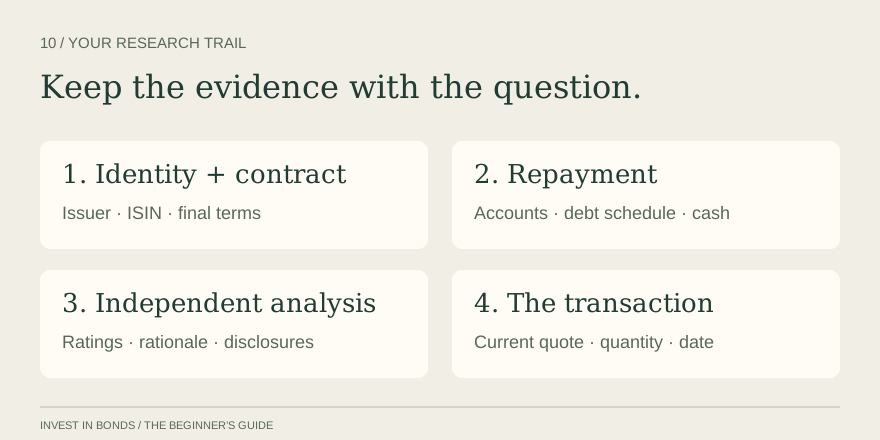 Keep the source, publication date and the question each document answers. View full-size diagram
Understand how the business gets cash
Start with a plain-English description of the issuer. What does it sell or finance? Who pays it? When does cash arrive? What commitments must it meet before your bond payments fall due?
A business can report profit and still face a cash shortage. Sales on credit are not the same as money already collected. A growing lender can depend on continued funding and borrower repayments. A project company may rely on particular contracts or milestones. The relevant questions vary by business model.
Try explaining the cash cycle without using the phrase “strong company”. If your explanation is mostly brand familiarity, keep researching. Recognition is useful for finding the business; it is not a financial analysis.
Read the numbers in context
Review recent financial statements and their notes, not just a single ratio. Look at borrowing, operating cash flows where relevant, cash and liquid resources, repayment schedules, guarantees and material contingent liabilities. Read the auditor’s opinion and any qualifications carefully.
Ratios can help organise the questions. Interest coverage considers earnings relative to interest expense under the chosen definition. Leverage measures compare debt with some measure of resources or earnings. But there is no universal number in this guide that makes every borrower safe. A ratio appropriate for a manufacturer may be misleading for a bank or an NBFC.
In a fictional business, operating cash received is ₹100, committed operating cash costs are ₹75, and interest plus near-term debt repayments total ₹40. The simple gap is ₹15 before other funding sources or cash balances. The example does not establish default; it identifies a funding question. Where will the missing cash come from, and how dependable is that source?
Look forward to repayment dates
Historical performance is useful evidence. Your bond, however, depends on future payments. Find the obligations due during the period you expect to hold it and the resources the issuer expects to use.
If repayment depends on issuing new debt, recognise the refinancing assumption. If it depends on selling an asset, ask what happens if the sale is delayed or raises less cash. If a report cites undrawn bank lines, understand their terms and availability rather than treating the headline amount as cash in hand.
You will not be able to prove every future outcome. The purpose is to identify the dependencies and decide whether you understand and can accept them.
Read strengths and concerns together
Take the latest rating rationale and write two columns: reasons supporting repayment and factors that could weaken it. Then compare those observations with subsequent announcements and financial statements.
Do not choose only the favourable passages. If a report discusses a concentration, a thin liquidity position or dependence on support, include it in your summary. A balanced note is more useful to your future self than a persuasive argument for a purchase you already want to make.
If two credible sources disagree, record both dates and scopes. One may refer to a different series or an older period. If the discrepancy remains unresolved, seek clarification through official channels. Missing information can justify leaving a bond off the shortlist.
Check the market evidence separately
Credit analysis does not tell you the current price at which you can buy or sell. Record whether the price is a historical trade, indicative valuation or executable quote. Add the quantity, timestamp, settlement terms, accrued interest and charges.
Suppose your investment case looks reasonable at a particular price, but the available quote changes before you order. Recalculate. “I already researched it” does not mean that any price now makes sense.
Write a one-page decision note
Use five short paragraphs: purpose, instrument, repayment case, risks and unresolved questions. Finish with the price and conditions under which you would consider the transaction. You can also decide to pass and record why.
For example: “This instrument’s minimum order would make my exposure to one issuer too large for the allocation I planned.” That is a complete reason to stop, even if every document is available and the company is well known.
Good research leaves a trail that you can check again when circumstances change.
A minute to think
What would make you revisit the decision after buying? Write down two or three developments, such as a rating change, a material financing announcement or a change in your own cash needs. Research becomes more useful when it also defines what you will monitor later.